The church, its history and a visit
Saint-Julien-le-Pauvre: the church
Saint-Julien-le-Pauvre in Paris: how it grew from a pilgrims' hospice to a Melkite church, what to look at inside, and how to visit.
Reserve your seat for the concert ↗Quick answer
Saint-Julien-le-Pauvre is a small church on the Left Bank, in the 5th arrondissement, begun in the 1160s and counted among the oldest in Paris. It started Romanesque and finished early Gothic, and since 1889 it has been the Melkite Greek Catholic parish church, with a carved Byzantine-style iconostasis. Entry on your own depends on the parish, so check on the day. A classical concert is the reliable way to sit inside.
Saint-Julien-le-Pauvre in five dates
| When | What happened |
|---|---|
| 6th century | Hospice and chapel on the site |
| 1160s | Work begins on today's church |
| 17th century | Nave shortened, new front |
| 1826 | Returns to worship |
| 1889 | Melkite parish takes over |
The church in brief
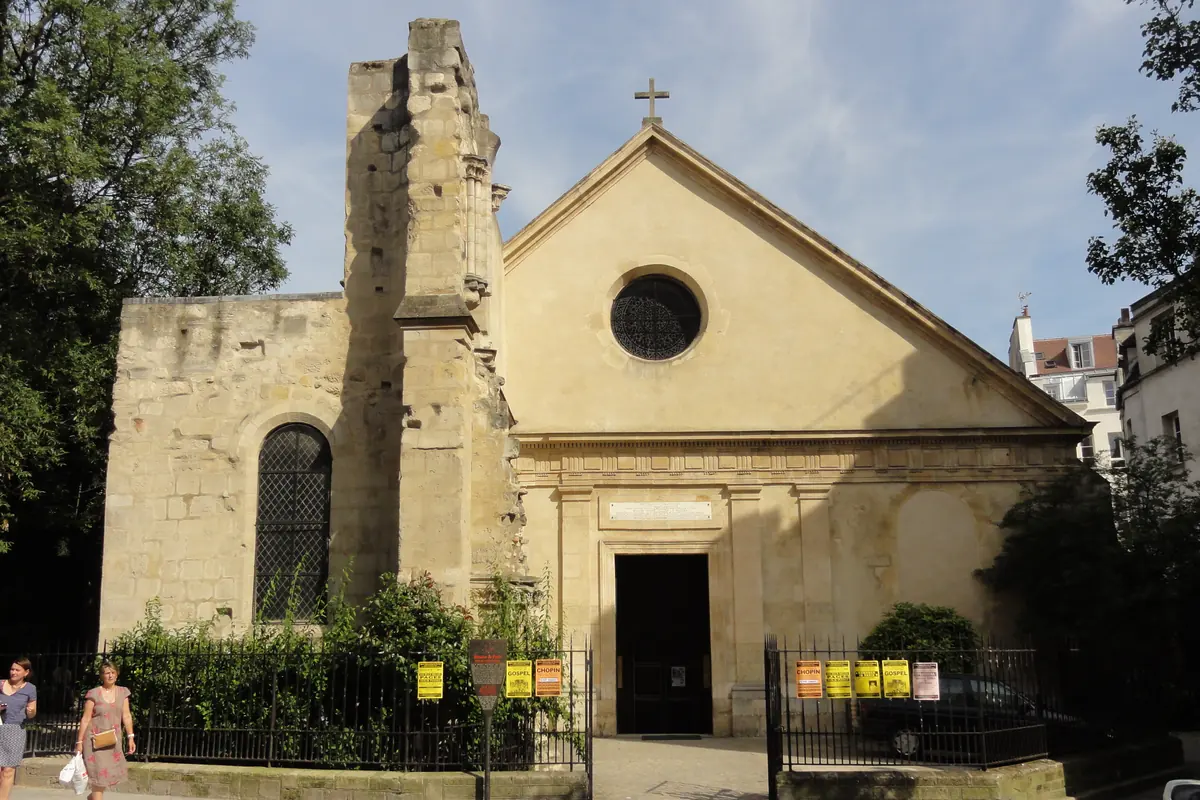
Saint-Julien-le-Pauvre stands at 1 Rue Saint-Julien le Pauvre in the 5th arrondissement, on the Left Bank, close to the Latin Quarter's old streets and across the river from Notre-Dame. From the street it looks modest: a plain west front with a round window and, beside it, the rough stump of a tower that was never finished. The interior is where the age shows: medieval columns, early Gothic vaults and a screen of gilded icons share one small room. The church is a working parish, home to the Melkite Greek Catholic community since 1889, and it is also a room where classical concerts are held.
From pilgrims' hospice to priory church
Written sources trace a hospice for travellers and pilgrims without money, with a chapel dedicated to a Saint Julien, to this site as early as the 6th century. The earliest buildings were wrecked by Norman raiders in the 9th. In the early 12th century the property passed to Cluniac monks of the priory of Longpont, who rebuilt it. Sources link the church's name to Julian the Hospitaller, Julian of Le Mans and Julian of Brioude, three saints who share the first name, which is why accounts of the dedication differ. The hospice matters to the story because it explains the church's place on a pilgrim road: travellers without money could find shelter, and the Camino-bound pilgrims who passed through the Left Bank are linked to the site in some accounts.
The 1160s: building beside Notre-Dame
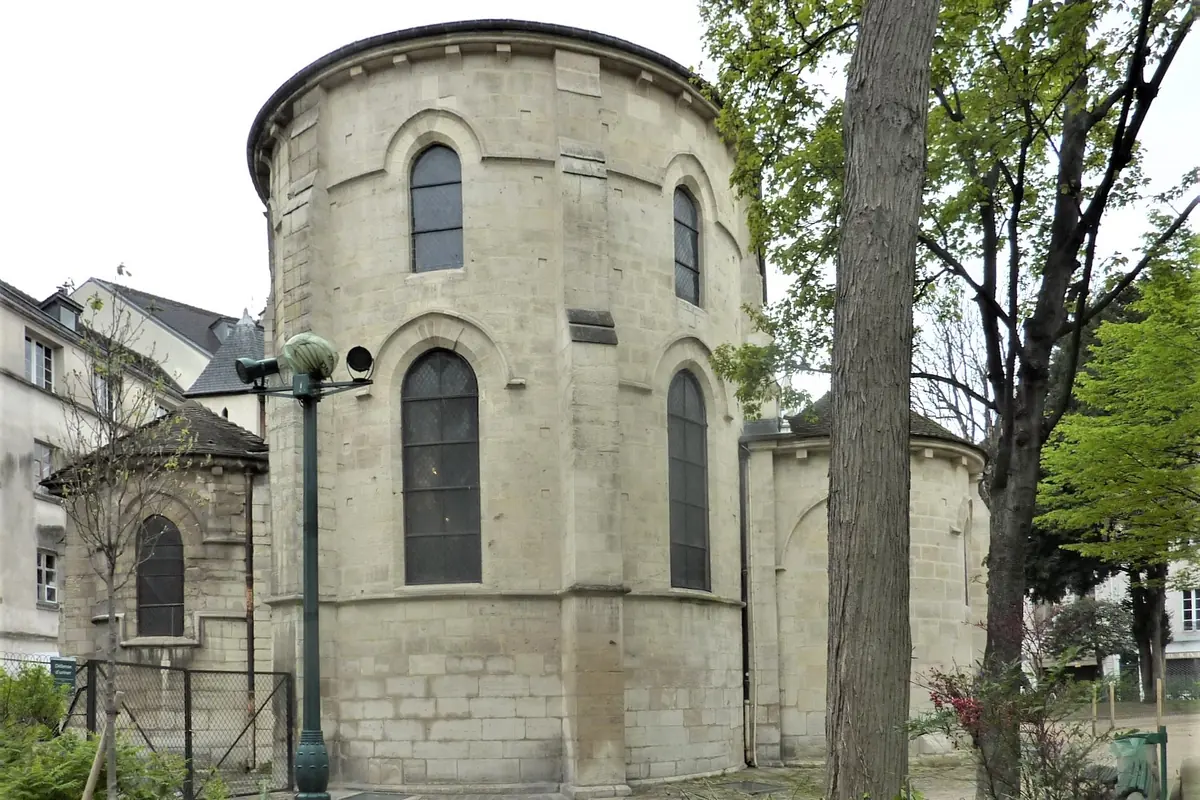
The church you see today was begun in the 1160s, in the years the cathedral of Notre-Dame was going up on the island. Work started in the Romanesque style and most of the building is early Gothic. The choir has early six-part rib vaults and was planned with three storeys, though the third was never built. The sculpture of the choir echoes Notre-Dame, and it may have been made by the same artists. The nave has four bays, with aisles on either side and pointed arches resting on round columns.
Capitals, water lilies and a harpy
Look up at the capitals, the carved tops of the columns. The 19th-century antiquarian Ferdinand de Guilhermy counted more than 150 of them, almost all different, and many are carved with the leaves of water lilies and other aquatic plants. One 12th-century column carries a harpy, a creature with a bird's body and a woman's face. They are small details, easy to miss in an evening light, but they are the reason a concert audience that arrives early has something to look at while the musicians tune.
The university church
The church stood close to the schools of medieval Paris, and the University of Paris held assemblies and lessons in it in the Middle Ages. The church was therefore part of student life long before it was a place visitors came to for music. The link faded as the university moved on, and by the 17th century the church had become an ordinary parish church. What survives today is a large fragment of the medieval building, not the whole of it, and that is worth knowing before you go: the church you visit is a shortened, patched, much-used survivor, and its charm lies in exactly that.
Loss and return, 17th century to 1826
In the 17th century the nave lost its two western bays and a new front was built, which is the plain façade you see now. During the French Revolution the church was closed and used as a salt store. It returned to Catholic worship in 1826 and was restored in the 19th century. Today it is protected: sources list it as a historic monument classed in 1846, which sets the rules for how it may be altered and kept. The history of loss and re-use helps to explain why the interior feels uneven and lived-in rather than polished. Nothing here reads as a showpiece, and that is part of its appeal.
A Melkite church since 1889
In 1889 the church was assigned to the Melkite Greek Catholic community, which made it the community's first parish in the capital. The Melkite Greek Catholic Church is an Eastern Catholic church in full communion with Rome, and it traces its roots to the Christian community of Antioch. It follows the Byzantine rite, the tradition that also shapes the interior you see, with icons in place of most statues. Parish services take place in the same room as the concerts, so the church is a living place of worship and not a museum.
The iconostasis
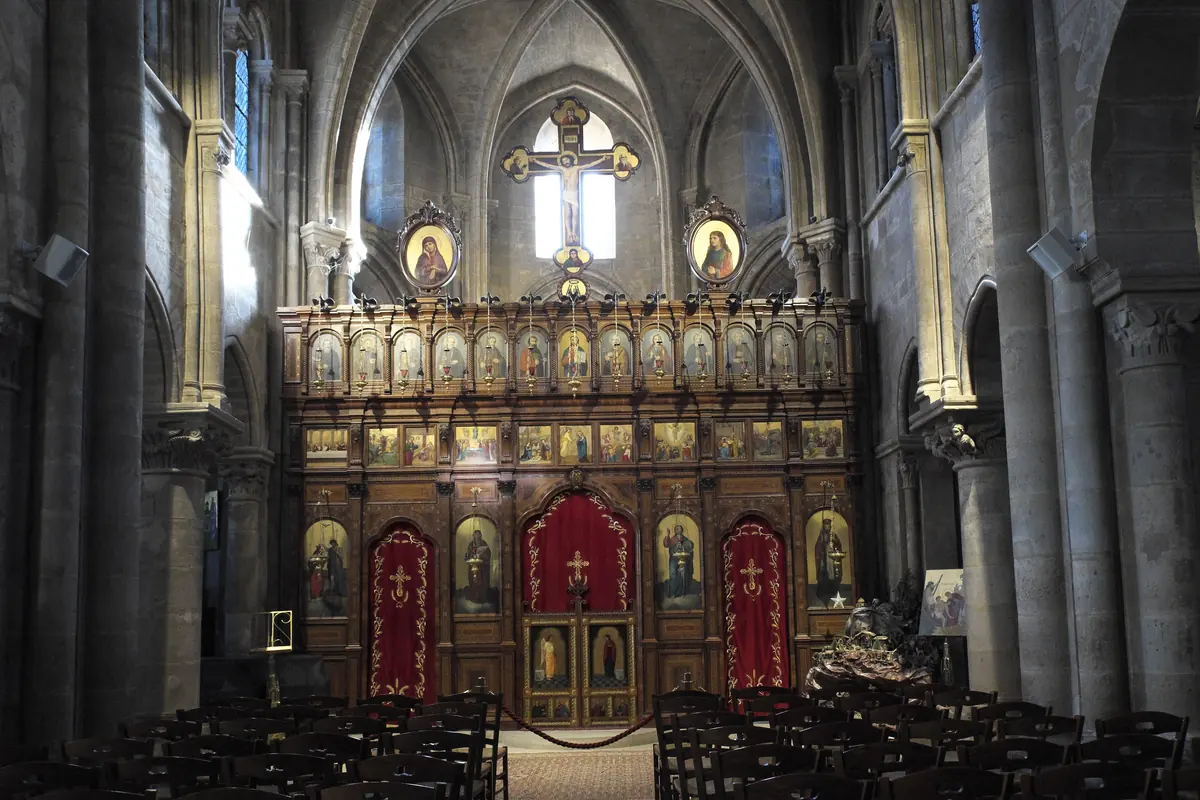
The carved wooden screen of icons that closes off the sanctuary is called an iconostasis. This one was made in Damascus by the cabinetmaker Girgi Bitar and inaugurated in 1891. In the 1950s the rector had its upper tier cut away to open up the view of the apse, which removed a row of icons. A restoration completed in 2012 rebuilt the screen to its original form. Together with the medieval columns around it, the iconostasis is the picture most visitors remember. A separate guide on this site explains how to read it.
Dada in the nave, 1921
On 14 April 1921 the artists of the Dada movement chose this church for an outing. The group included Tristan Tzara, André Breton, Philippe Soupault and Francis Picabia, and the day is remembered as the Dada excursion. It is a short episode, but it shows how long the church has been known in Paris as an odd, characterful corner of the Left Bank, a place people went to on purpose.
Visiting, and hearing a concert
The city's page for the church gives the address and says the church is accessible, with a removable ramp available for the two entrance steps; it advises contacting the church beforehand. It lists no regular opening hours and says hours may change, so check on the day. The reliable way to be inside is to book a seat at the concert, which runs for about 65 minutes; arrive in good time and look around before the music starts. Square René-Viviani, the small park beside the church, makes a natural place to wait. The concert guide on this site covers dates and tickets, and the Saint-Michel metro and RER station is the nearest large interchange.
Read next: Concert at Saint-Julien-le-Pauvre
Who this isn't for
This church is not for you if you want a grand cathedral interior, a long list of artworks, or guaranteed access at a time of your choosing. It is small, it is a parish church first, and its doors follow the parish's schedule. Visits can be limited during services. It is also not a substitute for the large Gothic cathedral across the river, which belongs to a different scale of visit altogether. If what you want is one quiet hour in an old Parisian room with music in it, it fits well.
Frequently asked questions
Is Saint-Julien-le-Pauvre really one of the oldest churches in Paris?
Yes, it is counted among the oldest. Work on the present church began in the 1160s, in the years Notre-Dame was being built, and a hospice and chapel stood on the site long before.
Is it a Catholic or an Orthodox church?
It is Catholic. Since 1889 it has been the Paris church of the Melkite Greek Catholic community, which follows the Byzantine rite and is in full communion with Rome.
Can I just walk in?
Not reliably. The city's page lists no regular opening hours and says they can change, so check on the day. A concert ticket is the dependable way in.
Why is there an icon screen instead of a high altar?
The iconostasis is part of the Byzantine rite the parish follows. Made in Damascus and inaugurated in 1891, it separates the sanctuary from the nave.
Is the church accessible?
The city's page says yes. A removable ramp is available for the two entrance steps, and the city advises contacting the church beforehand.
What is nearby?
Square René-Viviani, a small park beside the church, looks across to Notre-Dame. The Latin Quarter's streets and restaurants surround it.
Sources